19. Eurokaz Festival >> Productions>> K.O. / Kombinirane Operacije |

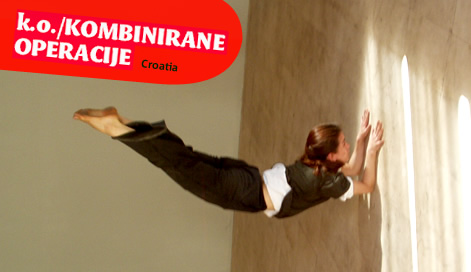
Roland Barthes: Lover's Discourse The artistic trio k. o. (COMBINED OPERATIONS) was formed in December 1998 and had their first onstage appearance at The Festival of Youth in Kikinda ( Serbia ) with the excess performance Exit . The group is comprised of: Saša Božić (director/dance dramatist), Željka Sančanin (choreographer, dancer/performer) and Andrej Vučenović (video artist). The first works of the group were conceptually founded on the confrontation of different cultural and ideological legacies that the members brought with them and linked with the problem of the status of the artist in a politically unstable time and space. Later on, their work was directed more towards dance and intensive choreographic research, and the interest for the "political" bodies from the initial phase was transferred to researching the pure physicality and phenomenology of movement. The group confirms their continuous interest for visual qualities of performing material in the solo choreography and video installation Private in Vitro, where they also radicalize previous choreographic elements by developing them into new modes of performativity which this time are directed towards the spectator and transferred from the performance field to the process of viewing, visual perception and the reproduction of the performed material. In 2005, in collaboration with a few invited artists, after a process that lasted a few years, they produce a performance Roland Barthes: Lover's Discourse based on the text of Roland Barthes - Lover's Discourse. Conceived as a multimedia happening, freely touching the delicate curves of Barthes' text, the performance questions the modes of author's creativity and collective work in the performative media. Starting from the thesis by the famous French philosopher on dislocation of the lover's language from the representative model of reality, the performance affirmes the inefficient possibilities of speech on human solitude and the necessity of mirroring in the Other through the augmented referenciality of language. The performance deals with the lover's discourse as a place of creation, a space where the language in its neglected, denied aspect, suprisingly becomes a model of a simulated, non-realistic action. In other words, the work on the project is directed towards the re-evaluation of the amourous discourse to the profit of a potentially structured performative fact. The project is defined through the differences between the performers; each performer brings his or her particular aproach to the given topics. The process of structuring the excercises is based on Barthes' idea of performing craving through the Other. The Other (be it the partner, the image, the object) serves as a medium that helps realize the desire for me. Within the process of rehearsal the performers moderate the beginnings of given scenic actions, testing them in different modes, in sequences of delays and redefinitions. Therefore the presentations of the project are each time differently structured, and they postpone the performative sacrosanctity, referring time and again to the process of testing. Spatially and temporally, the coexistence of the performer and the audience is treated differently, and the interactive changes are particularly interesting, because the share of the direct involvement of the audience within a given situation is gradually measured and mathematically directed. Each presentation consists of an audio-visual installation, performance or discussion, and of the presentation of a written archive, but can also include only one of the segments. After the performance, the group will present audio/visual installation Affective Etudes ( Sonata for a performer and metronome) which envisages the work process on the performance. Link: k.o. |
|||||||
|
|||||||


 |
 |
|
 |
 |
|
 |
||
 |
||
 |
||
 |
||
 |
||
 |
||
 |
||
 |
||
 |
||
 |
||
 |
||
 |
||
 |
||
 |
||
 |
||
 |
||