19. Eurokaz Festival >> Productions >> Rosas / Anne Teresa De Keersmaeker |

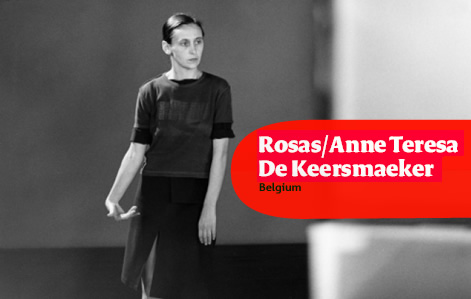
Once In the early eighties, there was a significant shift towards gestural theatre and dance. Anne Teresa De Keersmaeker changed the European theatre scene by introducing a completely new idea of movement. Already, with her first choreography Asch she perturbed us. Fase, four movements to the music of Steve Reich, which followed, was influenced by American post-modern dance (with which she was in contact during her studies at New York Tisch School of the Arts). She founded her own company, Rosas, in 1983. From the very beginning, its work has been characterized by unpredictability and radicalness. Within only a few years the group had achieved worldwide success and had succeeded in braking the, until then, invisible border between drama theatre and dance. Rosas performances are based on highly accentuated structures that reveal the painful process of construction. The shows from the mid-eighties, Rosas danst Rosas, Bartok/Aantekeningen (which was presented at the first Eurokaz) and Ottone, Ottone are today anthological examples of post-modern dance. In the 1990 performance Stella (with which invited to the fourth Eurokaz) the structural rigidity of previous pieces opened up a space for an intriguing aesthetic of agitated baroque theatricality. De Keersmaeker created a female piece and in that performance her personal way of working with dancers gained its full expression. In the performances that followed, she started introducing new elements - live music, video, and finally text. In the 1994 performance Kinok, a new choreographic departure is clearly visible: a dance vocabulary of inexhaustible unisons that blur the dancers' individuality slowly opens into a system through which each performer is revealed in their entirety. The strength of her choreographies has, since that moment, lain in the bringing together of very personal, intense performances within intricate and emphasized structures. In 1992 the group's residence became Théâtre de la Monnaie, the Bruxelles National opera, and De Keersmaeker became its artist-in-residence. From then on she tried to strengthen the relation between dance and music structures. In 1995, with the support of Théâtre de la Monnaie, De Keersmaeker succeeded in founding the international school of dance P.A.R.T.S. (Performing Arts Research and Training Studio), which filled the empty space made by the disappearance of Béjart's MUDRA in 1988. Her research into interaction between different performance elements reached its peak with the 2000 show In Real Time - a project that united all the dancers of Rosas, actors of an associate theatre group STAN and the musicians from the jazz assemble Aka Moon together on one stage. 2001 saw the return to pure dance with the performance Rain, and, in the performance Small Hands a preoccupation with relations of intimacy. Finally, in the performance Once, De Keersmaeker is alone on stage. Once is the crucial piece in De Keersmaeker's work that, like it or not, alters the course of understated, even repressed emotion on which contemporary dance frustrating seems to be set. Its grandeur and the astonishing amount of emotional force created by the solo seems to signal the return of an almost repentant engagement with neglected social issues. The silky, trembling voice of Joan Baez (the integral LP Joan Baez in Concert Part II ) was taken as the musical support for the dance. Vinyl records link the childhood and youth of the choreographer. Her fragile dance emanates from her intensely concentrated persona and is carried on the waves of the shiny melodies of the most socially sensitive folk singer of the sixties. They tell of painful introspection and tearing decisions. After 20 years of a mechanism of success that embraced numerous individual challenges, she returns to the stage alone, with her daydreams, with the voice of her body, and faces Joan Baez in concert, equally alone with her guitar. The choreographer rediscovers the seductive, untouched tenderness of a musical idiom and a fragile time. 1967 and the belief in equality, the struggle against all forms of human degradation, against violence of man over man: in today's atomized society it is a buried world, of which one hardly ever dares to speak.
|
|||||||
|
|||||||


 |
 |
|
 |
 |
|
 |
||
 |
||
 |
||
 |
||
 |
||
 |
||
 |
||
 |
||
 |
||
 |
||
 |
||
 |
||
 |
||
 |
||
 |
||
 |
||