June 27, Tuesday and June 28, at :00 pm
Croatian National Theatre, Trg maršala Tita 15
The Viennese Burgtheater, the Austrian National Theatre, founded in 1741 by the Empress Mary Theresa, remains the leading theatre in the German speaking world and one of the most influential internationally. The Burgtheater was where a number of plays by Thomas Bernhard, Elfriede Jelinek, Peter Handke, Peter Turrini and George Tabori first opened. All the leading German directors have worked at the Burgtheatr, which does not shun even such controversial projects as the Bernhard/Peymann Heldenplatz or the aggressive and spectacular stage actions of Christoph Schliengensief.
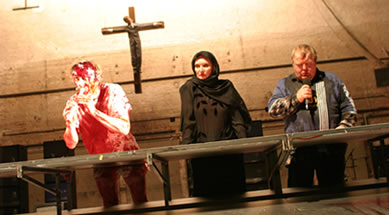
Having directed her Das Werk, Nicolas Stemann staged Jelinek's Babylon as the second part of his trilogy Wohlstand in Gefahr.
In Babylon, Elfriede Jelinek, winner of the Nobel Prize for Literature, presents the decay of our father-oriented culture, the restoration of archaic family cannibalism, the relations between mother and son, quite obviously the causes of the present barbarity, and poses the question whether the media images of wars and catastrophes have so numbed us that the classical repertory of human reactions, inconceivable without fear and compassion, has cancelled itself out. Jelinek focuses on three fundamental aspects – the political analyses of modern warfare; ethics and aesthetics in media perception and in reception of the arts; and the basic psychoanalytic confrontation father-mother-child, from whence all issues of violence and power spring.
The associative linguistic whirlpool of Jelinek's text draws in all and sundry: the war in Iraq and our media lust; the torturers from Abu Ghraib and the reawakened Christian fundamentalism of imperial America, pornography and liturgy, the moving figures of victims and criminals. The text meanders around the questions: “Please, what is the cause of this war?”, “Is this how a religion gets born?” and whether, in view of the media overload, “moral works of art” are still possible. All this embellished with sarcasm, irony, and self-ridicule of the producer of “bitter morality, on the rocks, please”. Elfriede Jelinek thinks and writes in musical terms, a sound calling forth another, and pays no heed to the rules of meaning and euphony.
Stemann builds a complex relationship with Jelinek's writing and the aesthetics of her theatre of cruelty. Together with his team he browbeats this text that resists representation into a spectacle that gets under the skin of the audience, spreading painful sensitivity and releasing anarchic associations. Stemann protests violently over the demands the text poses, becoming an unfaithful servant to his mistress, occasionally in an insolent and abstract manner, but he is above all a particularly skilled, knowing and creative reader, who is loath to sell his model short. The threads of the textual carpet are to be unpicked and enweaved into a new texture.
Not particularly merry, but intelligent for sure – notwithstanding the drastic relentlessness of Stemann's foregrounding of the images of the world become porn revue, its frenzied display spotlighting the kernel of the textual material. Is a moral work of art (still) possible, today? The way Jelinek's Suada poses this rhetorical question is more of a reprimand than a lament – and Stemann's staging, a tragicomic essay, gives a brilliant rhetorical answer to it.
Nicolas Stemann is one of the leading lights of contemporary German theatre. His first major work was the Terror-Trilogie, composed of Antigone, The Seagull, Terrorspiel and Leonce and Lena. The cycle Schizophrenie und Karriere, staged at the Hamburg Kampnagel, had a large impact throughout the German-speaking world, and his production of Hamlet at the SchauspielHannover was the centrepiece of major international festivals.
|
|