












 |
|||||
 |
|
|
|
|
|
|
|||||
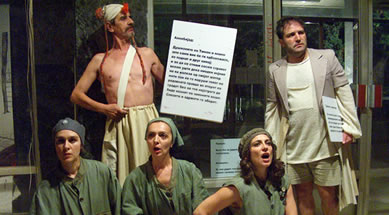
 July 1, Saturday, July 2, Sunday and July 3, Monday at 9:00 pm and 11:00 pm Primary School I. G. Kovacic - XVIII High School, Mesiceva 35 Shakespeare's Timon of Athens is a tragedy in five acts in verse and prose, dealing with human kindness, as well as the gluttony, vanity and insatiability of man. Inspired by the Dialogues of Lucian of Samosata, it is assumed to have been written about 1608, and was published in the First Folio in 1623. Timon is surrounded by flattery of his close friends, whose affection he buys with exclusive gifts. However, Timon manages to become aware of the ingratitude of his friends and withdraws to a cave in order to lead a life of hermit. Brezovec's production is a spectacular and shocking interpretation of the text: this intensive performance, which features Italian canzoni and Macedonian folk songs, also aims to engage the audience, placed in movable containers, pointing them towards the role of the people who failed Timon, denying his kindness, and thus brought about the moral decay of the polis. Brezovec takes on Shakespeare from a distance: everything has already been read, even Shakespeare, yet everything recurs and no moral framework becomes established. The incessantly converging and diverging play of fifteen actors in three languages, charged with unremittingly furious energy and the frenzied rhythm of futility, is subjected to this unprofitable effort. In staging a version of the play in which the protocol of the story is sidestepped, while its semiosis pointedly appearing in inane flashes, Brezovec builds an extraordinary work, employing the method of filigree, intimate collaboration in order to present the audience with an insight into the sickening contemporary aspect of Timon's tragedy. Moreover, Brezovec makes use of a highly original body language, composed of physical touch, hieroglyphs of sighing, sweating, and inner tensions, and the shifts in the dynamics of the actor's centre. The concept of the production is based on the claustrophobic encounter between the actors and the spectators. In physical terms, their proximity is a theatrical curiosity, even as the direction of their encounters provokes the guaranteed area of distancing. An enticing and uncharted experience is being created, a network of emotions exchanges diffidence for concern, and, once past the initial surprise, a genuine private stage is established, which does not fear monotony. The series of visual and dynamic delays leaves slight opportunity for spectatorial reflection, but the images are too precise, almost at the level of Brechtian gestual significance, for the concluding summing up not to be in the offing. The sound and music recall the idea of the epic theatre, while the use of a banners as practically sole props enables the para-iconoclastic perspective of the central part of the performance. This remarkable and wise production offers fragments of Shakespeare's text on over two hundred cardboards as a modus of economic and financial transaction, as representation of the loss of faith in the immediacy of conversion and the shaken belief in the use of art. Timon of Athens is a new theatre initiative, a carnival of flesh and passion gathered around violated laws, magnificent and gorgeous, an epic opera staging the enormity of our mutual mistrust. The director Branko Brezovec presents his work at Eurokaz festival from the beginning. His early productions, with their sometimes inaccessible, but always uncompromising style, never failed to cause virulent reactions of the critical establishment. For over a decade, though, his projects with various Macedonian theatres, are the highlights of the festival (Baal, King Hamlet, Bacchanal, Life of Caesar, to mention only the most prominent ones). The last couple of years, Eurokaz featured his spectacular ZeKaeM productions The Grand Master of All Vilains and Kaomv, Necrography/ Moulin Rouge. The audiences of Eurokaz already had a chance to see several productions by the National Theatere of Bitola, Magna Charta (Eurokaz ´87), Black Hole (Eurokaz ´88) and Life of Caesar (Eurokaz ´03), whileThe Turkish Theatre of Skopje presented its King Hamlet at Eurokaz ´95. Laboratorio Noveof Florence is dedicated to the exploration of contemporary stage practices, and is particularly drawn to the region of the Balkans; the ensemble is distinguished for its expressive and radical style of playing. At Sarajevo MESS festival in 2005, the production Timon of Athens won the prize by magazine Dani – Brave New World awarded by the critics present at the festival and the award The Kex of Tmace for the best direction. |
|||||
|
|||||
|
|||||
 |
|||||